
Madison County Court Records After Arrest
A Madison County jail arrest and a Madison County court case are linked, but they are not the same record. The jail record tracks custody, booking, release, and sometimes a booking photo. The court record tracks filed charges, hearings, bond orders, amended counts, warrants, pleas, dismissals, and sentencing. Misdemeanors and early felony matters often touch Madison County Municipal Court, while felony cases proceed through Common Pleas after indictment, bindover, or another felony filing route.
The Prosecutor's Criminal Division is part of that path. The Madison County Prosecutor Criminal Division says its attorneys provide 24-hour legal assistance to law-enforcement agencies and help prepare arrest and search warrants. The prosecutor decides what charges to pursue, and the court docket shows what was actually filed. For custody status and booking detail, use Madison County jail inmate records. For booking photos, use Madison County jail mugshots.
Find Madison County Court Records
The main case-search route is the Madison County Clerk of Courts search interface. The county's Clerk record-search entry page points users to that search and gives search tips. Municipal Court also has a record-search entry page with a public-data disclaimer. Search the court record after checking the jail roster because the roster can give the exact name spelling, while the court case gives the formal charge status.
- Search the jail roster first for the person's exact display name and any visible case or booking clue.
- Search the Clerk interface by defendant name, using last name then first name when that format fits the search tips.
- Use a case number when one is known, and enter case numbers without dashes or letters if the portal instructs it.
- Open the case and compare each charge, hearing, bond order, warrant entry, and disposition to the booking record.
- Contact the clerk or Municipal Court for certified copies, missing images, or older document access problems.
The manifest screenshot of the Madison County Clerk search interface shows the public case-search controls used for name, case number, file-date, and hearing-date lookups.
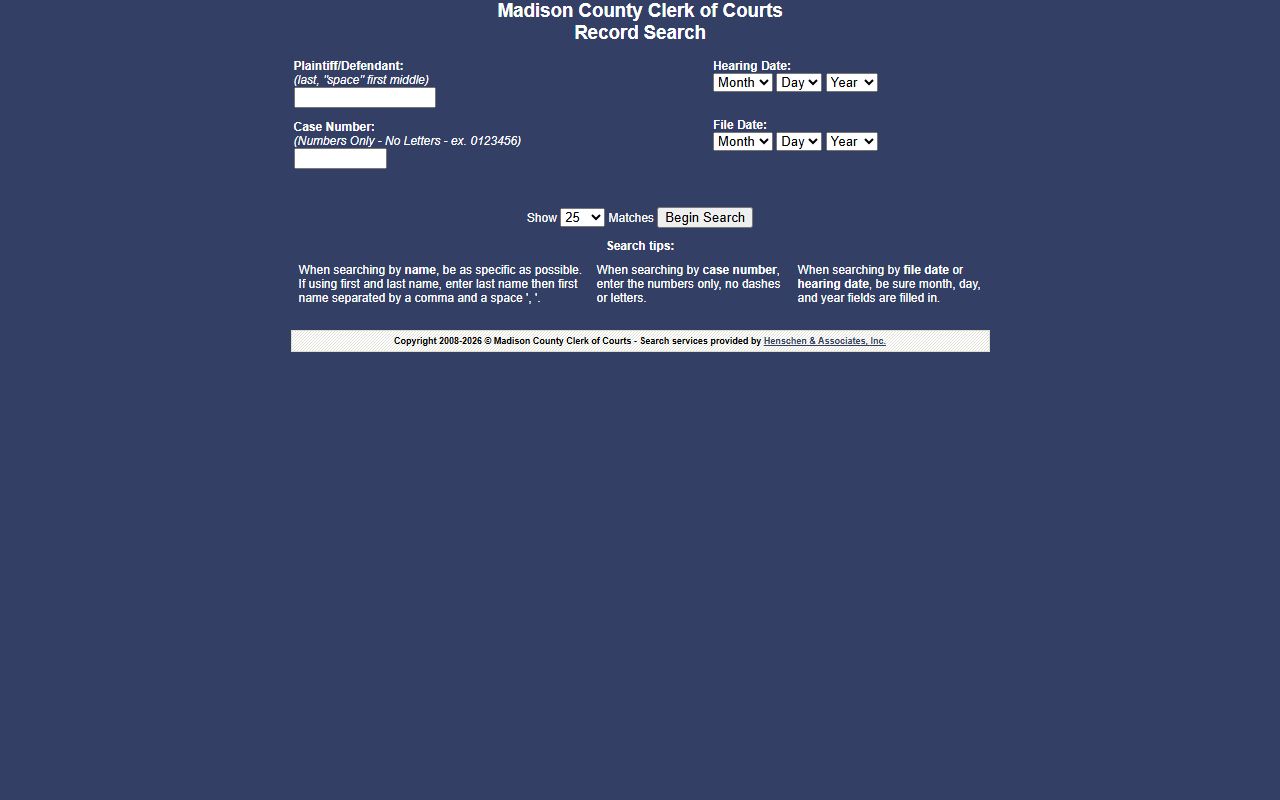
That search page is the best starting point when a booking has moved into a formal court docket or a felony case has reached Common Pleas.
Madison County Court Search Fields
The Clerk search interface exposes several ways to narrow court records after an arrest. Name searching is the broadest route, but case numbers, file dates, and hearing dates help when common names return too many matches. Municipal Court's static entry page did not expose the same detailed form fields in the research, so use its contact and record-search link as the fallback for misdemeanor and traffic-criminal matters.
| Field Label | Type | Required | Notes |
|---|---|---|---|
| Show | Dropdown | No | Options include 25, 50, 100, or 250 matches |
| Search | Text | No | General search box |
| Name | Text | No | Search tips recommend last name, comma, space, first name when using both names |
| Case Number | Text | No | Use numbers only, without dashes or letters |
| File Date | Date fields | No | Month, day, and year fields should be filled |
| Hearing Date | Date fields | No | Useful when a court date is known from the jail or bond paperwork |
Charges After a Jail Arrest
After a Madison County arrest, the first jail entry may reflect arresting-agency language. The court record begins when a charging document or court filing opens the case. A complaint can start a misdemeanor case or an early felony process. An indictment is a grand-jury charging document for felony cases in Common Pleas. An information is a prosecutor-filed formal charge used in some felony waiver or plea contexts. These documents are different from a jail card because they are court filings.
| Document | Common Role | Where It Appears |
|---|---|---|
| Complaint | Initial charge after arrest or citation | Municipal or preliminary felony docket |
| Information | Prosecutor-filed felony charge when indictment is waived or not used | Common Pleas docket |
| Indictment | Grand-jury felony charge | Common Pleas docket |
| Docket entry | Timeline of filings, hearings, warrants, and disposition | Clerk or court case record |
Madison County Charge Status
Charges can change after booking. A prosecutor may amend a charge, reduce it, add a count, dismiss it, or take the case toward indictment. A jail roster may still show the arrest charge that started the process, while the court record shows the filed and updated charge. That is why court records after a jail arrest should be checked before drawing any conclusion from a booking line.
| Status | What It Means |
|---|---|
| Pending | The case or charge remains active and has not reached a final disposition. |
| Amended or Reduced | The charge wording, statute, degree, or level changed during the case. |
| Dismissed | The charge ended without a conviction on that count. |
| Nolle Prosequi | The prosecutor declined to proceed or dismissed the charge by entry. |
| Bound Over | A preliminary felony matter moved from municipal process toward Common Pleas. |
| Indicted | A grand jury returned felony charges for Common Pleas proceedings. |
Bond Orders After Arrest
Madison County bond information comes from a court order, warrant, jail release process, or docket entry. No official Madison-specific bail fee table was located in the research. For a new arrest, a judge or magistrate may set or review bond at the first appearance. For a warrant arrest, the warrant may already carry a bond. A person can remain in custody after bond is addressed if another hold, detainer, parole issue, federal writ, or ICE matter applies.
| Bond Type | How It Works |
|---|---|
| Cash Bond | Cash or certified funds are required under the court's order, subject to local payment rules. |
| Surety Bond | A licensed bail agent posts surety for a fee under Ohio's commercial bail system. |
| Recognizance Bond | Release is based on a written promise to appear, often with conditions. |
| No-Bond Hold | The person cannot be released by posting money alone. |
| Detainer or Holder | Another agency asks the jail to hold or notify before release. |
Warrants and Court Arrest Records
No official Madison County Ohio sheriff active-warrant search page was located. The prosecutor's criminal division page confirms local warrant work because it says attorneys provide legal services in preparation of arrest and search warrants. Public warrant checks should therefore use the issuing court, the court docket, the sheriff's office, and attorney guidance rather than an assumed public warrant list. Municipal Court can be checked for bench warrants or failure-to-appear entries in municipal cases. Common Pleas and Clerk records can show capias, bond revocation, or felony warrant docket entries.
Someone who believes a warrant exists should understand the risk of walk-in arrest. Contacting an attorney or the issuing court before appearing at a law-enforcement counter can reduce confusion about bond, surrender, and hearing scheduling.
Charges vs Convictions
An arrest charge is an accusation, not a finding of guilt. Court records after a jail arrest can show that a charge was filed, amended, dismissed, reduced, or resolved by plea or trial. A conviction requires a guilty plea, no-contest finding with judgment, trial verdict, or another court disposition that legally establishes guilt. Readers should not treat a jail roster entry or pending charge as a conviction.
| Charge | Conviction | |
|---|---|---|
| Stage | Accusation or filed count | Final guilt finding or plea-based judgment |
| Can Change | Yes, charges may be amended, reduced, or dismissed | Changes require later court action such as appeal, sealing, or expungement where allowed |
| Record Use | Needs context and current status | Still must be verified with the court for official use |
Sealed and Expunged Records
Ohio Revised Code 2953.32 governs sealing or expungement of certain conviction records and bail forfeiture records, with exceptions. Sealing restricts public access to eligible records. Expungement is a stronger remedy where the law allows removal or destruction of the record. Eligibility depends on the case type, disposition, waiting periods, prior record, and statutory exclusions. A dismissed or eligible case does not vanish from every private copy on the internet just because a court later limits public access.
| Sealed | Expunged | |
|---|---|---|
| Public Visibility | Hidden from most public access after court order | Removed or treated as not existing where the statute allows |
| Government Access | Some agencies may retain limited lawful access | Access is more limited, subject to Ohio law |
| Eligibility | Depends on ORC 2953.32 and related rules | Depends on offense, disposition, and statutory exceptions |
Copies and Older Case Files
Older case images may need clerk help. The county Clerk record-search page references a legacy DjVu browser plug-in for older document viewing and notes that the plug-in works only with Internet Explorer. If a docket appears but document images do not load, contact the clerk counter for access options and certified-copy rules. The Municipal Court page lists the court at 55 North Oak Street in London, with business hours Monday through Friday, 8:00 AM to 4:00 PM, except Ohio legal holidays. The Common Pleas court page links to Record Search, Adult Probation, and Pre-Trial Services.
The municipal record-search page screenshot in the manifest comes from Madison County Municipal Court's record search entry.
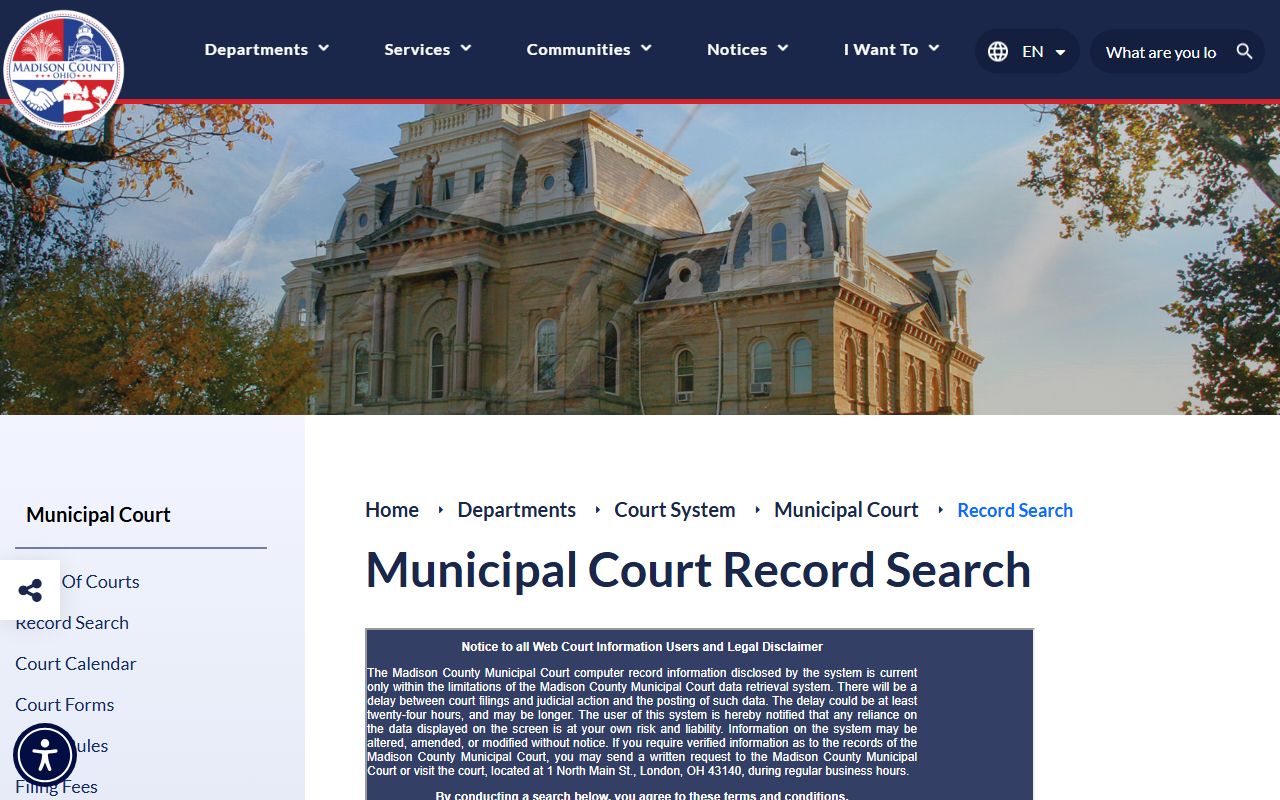
Use that court channel when the arrest is tied to a misdemeanor, traffic-criminal matter, preliminary felony step, or municipal bench warrant.
Restricted Arrest Court Records
Some records are restricted even when most court information is public. Juvenile matters, sealed charges, expunged records, protected victim data, medical information, and certain confidential law-enforcement investigatory materials may be withheld or redacted. Ohio public-record law gives access to existing public records, but it does not erase all exemptions. A court clerk can explain whether a record is public, sealed, unavailable online, or available only by in-person or written request.
Important: Madison County Inmate Population is not a consumer reporting agency and cannot be used for FCRA-covered screening decisions.